


Recently, the research team from the Research Center for Hydrogen Energy and Ammonia Applications of the Institute of Energy, Hefei Comprehensive National Science Center, published a cover paper in Issue 9 of Engineering, the journal of the Chinese Academy of Engineering. The paper, titled “Experimental Study on Ammonia Co-Firing with Coal for Carbon Reduction in the Boiler of a 300-MW Coal-Fired Power Station”, reports their research achievements on ammonia co-firing for carbon reduction in coal-fired boilers.
The paper used a 300 MW coal-fired power station boiler as the verification platform for ammonia co-firing. By installing two layers of eight pure-ammonia burners, it achieved, for the first time internationally, ammonia co-firing at heat ratios of 20% to 10% under generating unit loads ranging from 180 MW to 300 MW. The experiments investigated the effects of operating oxygen content, ammonia injection position, unit load, and ammonia blending ratio on flue gas NO? emission characteristics and ammonia burnout characteristics. The impacts of ammonia co-firing on boiler heat transfer and thermal efficiency were also examined.
The study found that:
NO? emissions in the flue gas are adjustable and controllable. Compared with pure coal combustion, NO? emissions during ammonia co-firing are more sensitive to changes in boiler operating oxygen content. Under fuel-rich conditions, the high-temperature reduction effect in the furnace becomes active, and NO? emissions can even be lower than those under pure coal conditions. Under all test conditions, the ammonia concentration at the furnace outlet was less than 1 ppm, indicating complete ammonia burnout.
Ammonia co-firing has a minor impact on boiler thermal efficiency. Compared with pure coal combustion, it causes a slight increase in sensible heat loss of water vapor and unburned solid loss in the flue gas, resulting in a small decrease in boiler thermal efficiency (0.12%–0.38%). Within the tested unit loads and ammonia blending ratios, the existing boiler heating surfaces fully meet the heat transfer requirements without any modification.
This work was supported by the National Key R&D Program of China, the Academy-Local Cooperation Project of the Chinese Academy of Engineering, the National Natural Science Foundation of China, the Natural Science Foundation of Anhui Province, the University Synergy Innovation Program of Anhui Province, and independent research projects of the Institute of Energy, Hefei Comprehensive National Science Center (Anhui Provincial Energy Laboratory). The paper also includes collaborators from Anbang Technology Co., Ltd. and the Institute of Plasma Physics, Hefei Institutes of Physical Science, Chinese Academy of Sciences.
The research team will further explore the characteristics of ammonia-coal co-firing and its impact on boiler performance under higher blending ratios and in larger generating units, continuing to contribute to the widespread application of ammonia co-firing as a carbon reduction technology route for coal-fired power units.
Paper Link: https://www.engineering.org.cn/engi/EN/10.1016/j.eng.2024.06.003
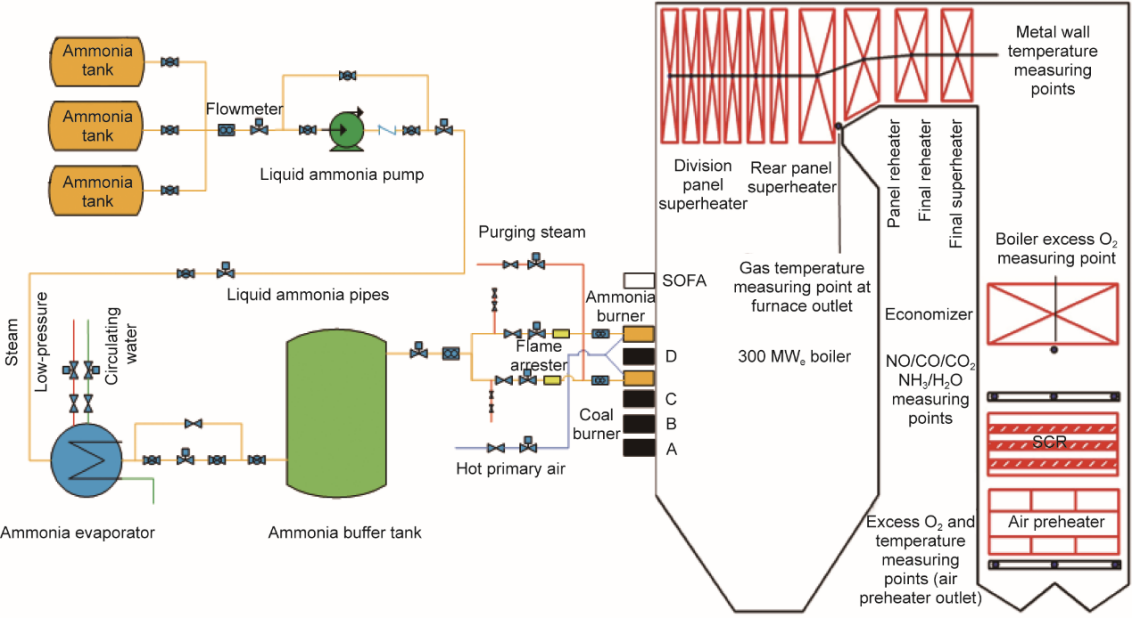
Figure 1 Schematic of the ammonia co-firing system for a 300 MW coal-fired power station boiler
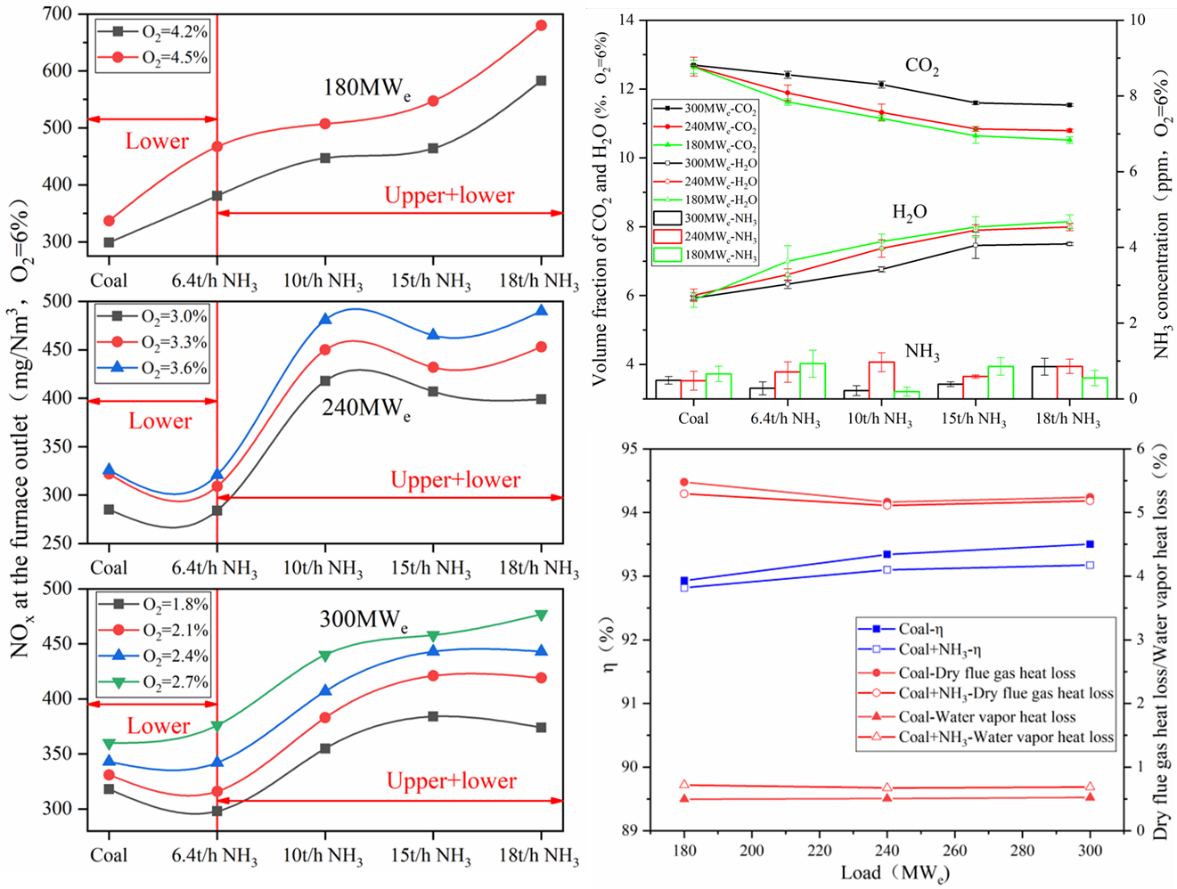
Figure 2 Effects of boiler operating oxygen content, ammonia injection rate, and unit load on flue gas NO?, ammonia concentration, and boiler efficiency