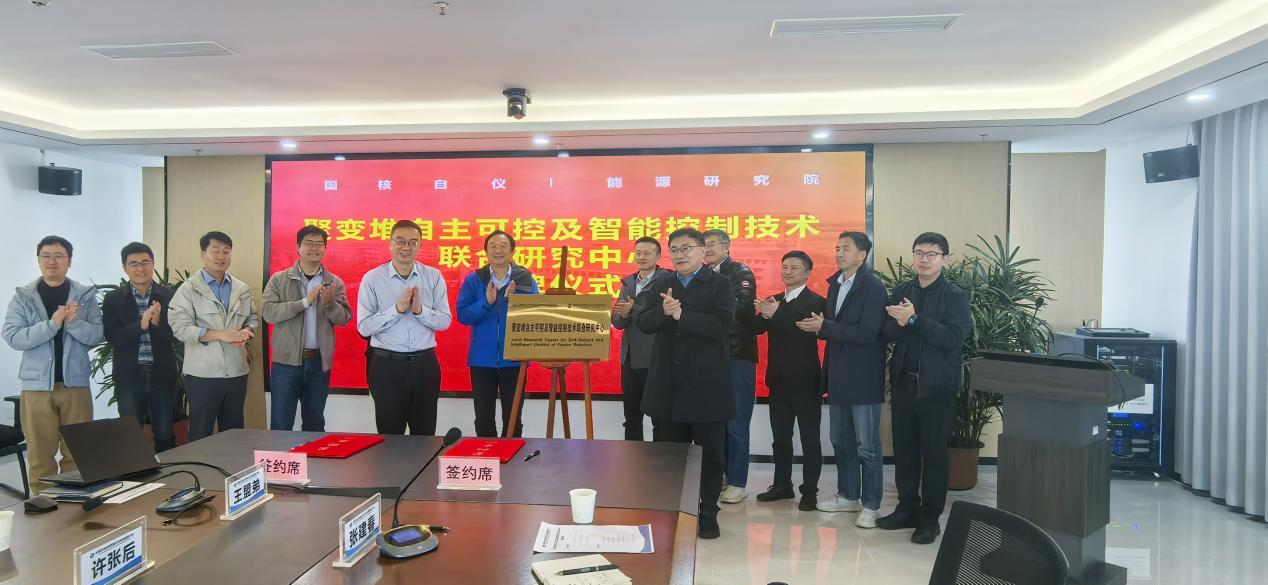
To provide strong support for accelerating the autonomy, localization, and engineering application of core control system technologies for fusion reactors, the Institute of Energy has reached an agreement with SNPTC Automation Instrumentation Co., Ltd. to jointly establish the “Joint Research Center for Autonomous, Controllable and Intelligent Control Technology of Fusion Reactors”.
Recently, the two parties held a signing and unveiling ceremony for the co-construction agreement in Hefei. Witnessed by Researcher Li Jiangang, Chief Scientist and Director of the Scientific Committee of the Institute, and other guests, Hu Haomin, Executive Vice President of the Institute of Energy, and Zhou Haixiang, Deputy Secretary of the Party Committee and General Manager of SNPTC Automation Instrumentation Co., Ltd., signed the co-construction agreement and unveiled the plaque for the Joint Research Center.
According to the agreement, the Joint Research Center will focus on addressing the challenges of making the core control system of fusion reactors autonomous and controllable. It will integrate advanced technologies such as artificial intelligence, virtual simulation, and digital twins to develop an intelligent control system for fusion reactors that reaches internationally leading levels.
Researcher Li Jiangang pointed out that the Joint Research Center should focus on the goal of achieving autonomy and localization of both software and hardware for the intelligent control system of fusion reactors. It will build an innovation consortium that closely integrates industry, academia, research, and application, realize strong collaboration and complementary advantages, and provide a solid guarantee for the safe and reliable development of the fusion industry.
General Manager Zhou Haixiang stated that SNPTC Automation Instrumentation Co., Ltd. will uphold high standards, fulfill its social responsibilities and mission as a state-owned central enterprise, and contribute to advancing the energy technology revolution and safeguarding national energy security.