


On August 5, 2025, the large-span tower lightning comprehensive observation and positioning monitoring equipment designed by the Institute of Energy, Hefei Comprehensive National Science Center (hereinafter “the Institute”) successfully passed on-site commissioning and acceptance at the Yangtze River large-span section of the Bai-Zhe Line in Chizhou, Anhui. This marks the successful completion of the preliminary infrastructure construction phase of the project. From now on, the project officially enters a 2-to-3-year period of multi-physics observation and monitoring data collection for the lightning-struck large-span section.
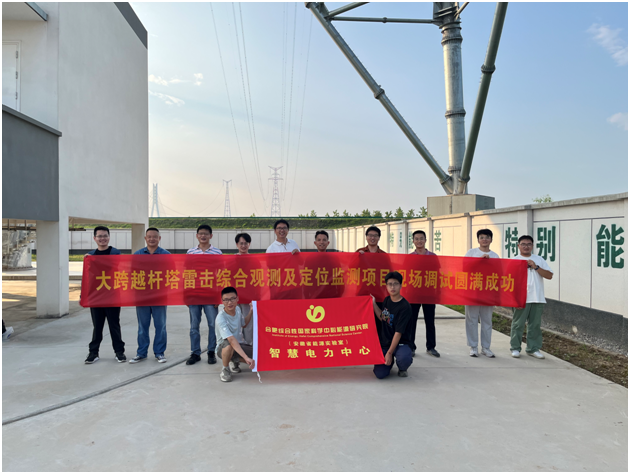
On-Site Commissioning and Acceptance
The comprehensively observed and positioned monitoring equipment successfully put into trial operation is a specialized monitoring device designed for large-span towers. Its purpose is to obtain accurate lightning current waveforms and reliable lightning strike positioning points. The device innovatively adopts non-contact lightning current inversion technology and integrates a high-speed imaging system with intelligent triggering function, effectively overcoming the technical bottlenecks of the traditional Rogowski coil closed-loop measurement method — such as low cost-effectiveness on large-scale equipment and difficulty in identifying lightning strike points. It will continuously accumulate key data through systematic long-term observation to deeply analyze the lightning attraction characteristics of large-span tower sections, thereby providing a solid scientific basis for lightning fault analysis and protection improvement of large-span transmission lines.
On the same evening, a progress report meeting on the trial operation of the large-span tower monitoring system was held at the Transmission Centralized Monitoring Center of State Grid Chizhou Power Supply Company. Leaders and technical experts from China Energy Construction Group Anhui Electric Power Design Institute Co., Ltd., State Grid Chizhou Power Supply Company, and Hefei University of Technology attended the meeting. Dr. Wang Chaoqun, the project leader, presented the project overview, core achievements, and subsequent work plan. The attending leaders and experts highly praised the smooth phased progress of the project and the demonstrated technical innovation. They unanimously agreed that the successful commissioning of this monitoring system fills a research gap in comprehensive lightning observation for domestic UHV large-span projects in China. They also expressed the expectation that it will establish a refined lightning strike characteristic database to provide key data support for future lightning protection improvements. The project team of the Institute of Energy stated that they will earnestly implement the experts’ suggestions, continuously optimize positioning accuracy, conduct in-depth research on the unique lightning attraction characteristics of large-span structures, and contribute to advancing China’s lightning protection technology and ensuring the safety of major power transmission corridors.
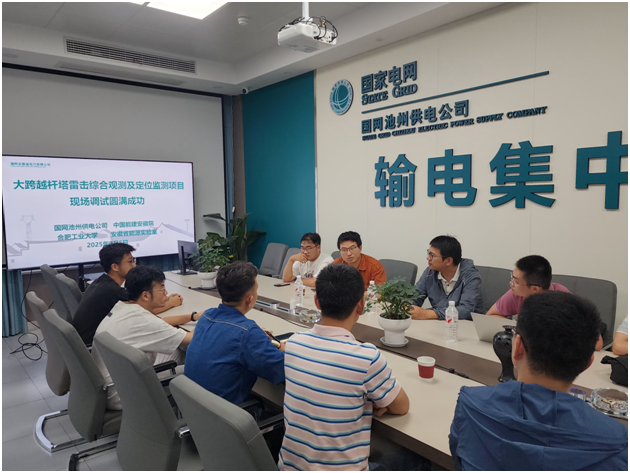
Project Achievement Report