


Currently, as China’s “dual carbon” strategy is implemented in depth, promoting green, low-carbon, clean and efficient new energy propulsion technologies in inland waterway shipping and maritime transport has become a global consensus in the shipping industry and an important future development trend.
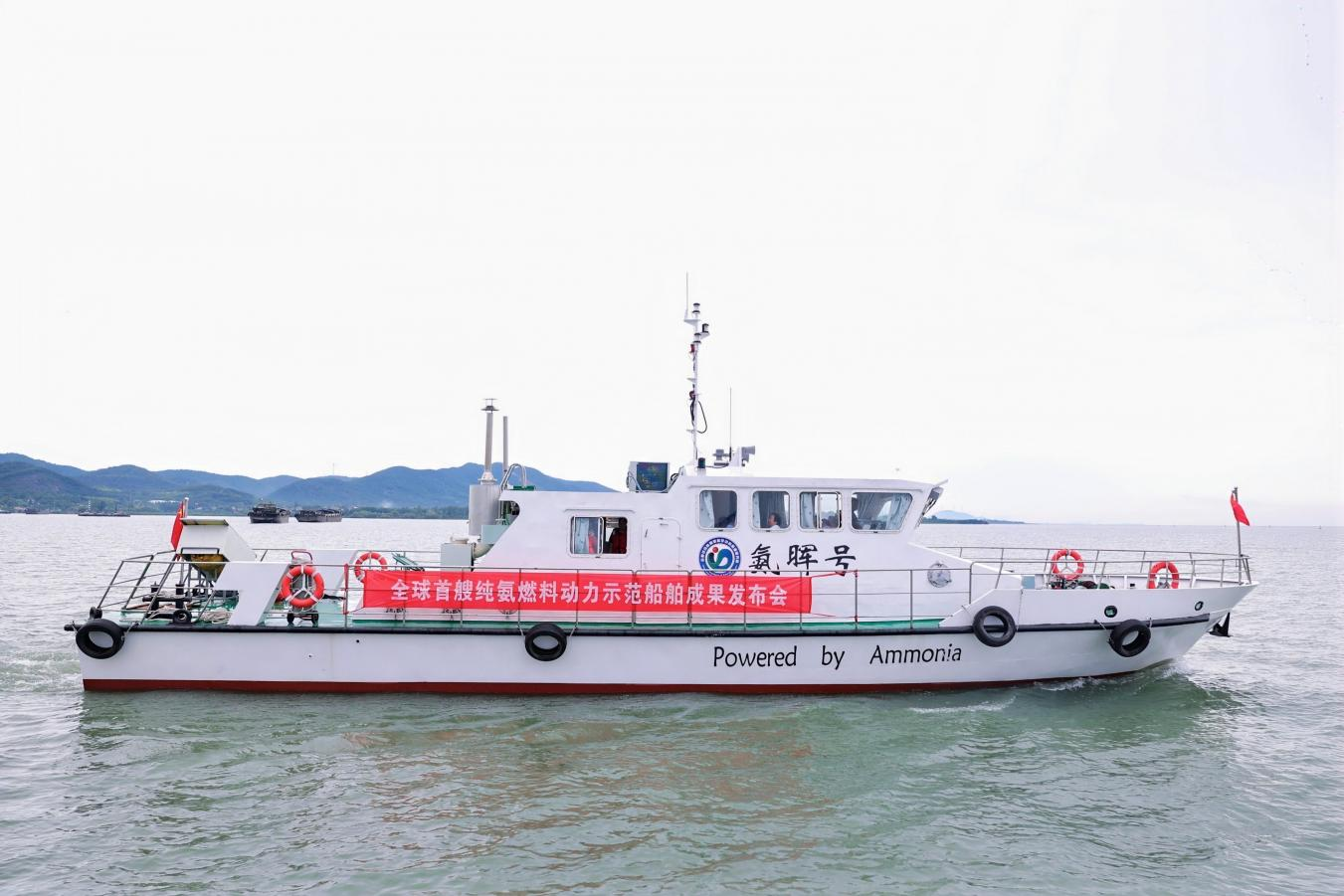
On June 28, 2025, the world’s first demonstration vessel powered by a pure ammonia-fueled internal combustion engine, “Anhui”, jointly developed by the Institute of Energy, Hefei Comprehensive National Science Center (hereinafter “the Institute”) and its subsidiary Shenzhen Haixu New Energy Co., Ltd. (hereinafter “Haixu”), successfully completed its maiden voyage on Chaohu Lake in Hefei, Anhui. This achievement marks a major breakthrough in the industrial application of ammonia fuel in the shipping sector. It opens a practical new pathway for energy conservation, emission reduction, and green development in the shipping industry, and holds milestone significance for accelerating the construction of a clean, low-carbon, safe, and efficient waterborne transportation energy system.
To effectively reduce carbon emissions in the shipping industry, the Institute of Energy took proactive and forward-looking actions. In 2023, it jointly established Haixu New Energy Co., Ltd., a company specializing in clean energy development, together with expert teams in shipbuilding, energy, and power sectors. Targeting one of the top ten scientific frontier issues — “achieving efficient combustion and near-zero emission control of zero-carbon high-power internal combustion engines using ammonia-hydrogen blended fuel” — the Institute took the lead in conducting cutting-edge research on pure ammonia fuel as a clean, zero-carbon power source for ships. With strong support from institutions and experts including CSSC 712 Research Institute, CSSC 719 Research Institute, Henan Diesel Engine Heavy Industry Co., Ltd., Chongqing Hongjiang Machinery Co., Ltd., Sinovation Ventures, Dalian University of Technology, and Shenzhen Polytechnic University, the team achieved a series of major breakthroughs after more than two years of dedicated research:
First, the team overcame multiple key core technologies, including pure ammonia fuel plasma ignition technology, pure ammonia fuel continuous combustion technology, high-efficiency catalytic cracking of ammonia to produce hydrogen, modular design and manufacturing technology for pure ammonia fuel supply systems, and efficient combustion and control technology for ammonia-hydrogen blended gas fuel in gas internal combustion engines. Haixu has secured several invention patents, filling previous gaps in China.
Second, the team independently developed key equipment such as pure ammonia fuel burners, various high-efficiency ammonia catalytic cracking hydrogen production devices, pure ammonia fuel supply systems, and modular pure ammonia fuel supply and control systems — all of which are first-of-their-kind innovations in China.
Third, the team designed and built the world’s first demonstration vessel powered by a pure ammonia-fueled internal combustion engine — “Anhui”. The vessel is equipped with a 200 kW high-speed gas internal combustion generator set, two 100 kW propulsion motors, and a twin-propeller propulsion system. It has a full-load displacement of 50 tons and a rated speed of 10 knots.
Fourth, the team successfully completed the on-water trial. After completing key technology verification and system integration testing on land, the launching and trial voyage on Chaohu Lake achieved complete success, realizing the expected goals of stable and full combustion of pure ammonia fuel, near-zero carbon dioxide emissions, and effective control of nitrogen oxides (NOx).
The successful operation of the pure ammonia-powered demonstration vessel is of epoch-making significance. It fully validates that ammonia-hydrogen blended fuel can be widely applied in the future to maritime transport, land transportation, industrial and domestic boilers, and solid oxide fuel cells, thereby contributing to the achievement of China’s “dual carbon” goals. Going forward, the technical teams of the Institute of Energy and Haixu will follow the logic of marketization and industrialization, further strengthen technological breakthroughs, optimize engineering solutions, upgrade related equipment, and continuously improve the vessel’s safety, stability, reliability, adaptability, and economic performance. At the same time, they will vigorously develop standardized and serialized products, laying a stronger foundation for the large-scale application and industrialization of ammonia fuel.